
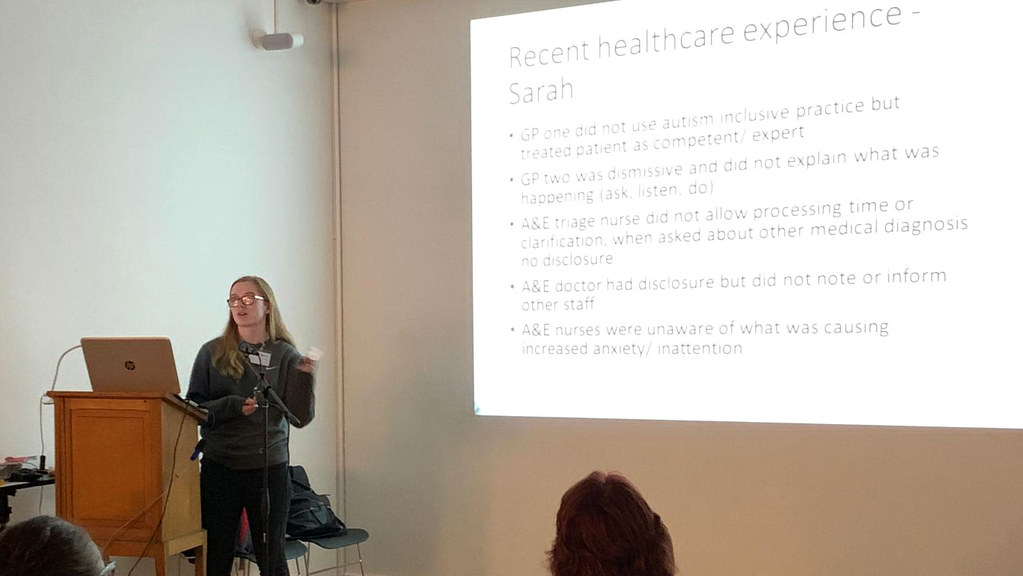
Researchers and from the hosted a workshop informed by their research into adapting interviews for autistic people.
Service providers and professionals working with the general public attended from sectors including:
- health/medical
- employment
- education
- the Criminal Justice System (CJS)
- the third sector
Attendees were facilitated by academics and autistic people to create evidence-based adaptations tailored to improve communication with autistic people accessing their services.
The workshop was funded by the .
Ambassadors for Autism
The evaluations from the workshop indicate that attendees found the event very useful to their practice, and many are now implementing changes within their services in order to become Ambassadors for Autism.
Service providers and other professionals working with autistic people can pledge to become Ambassadors for Autism by making adaptations, such as:
- modifying communication
- adapting the environment to reduce sensory stressors
- providing information and materials in different formats
Ambassadors work with CAAR to create their evidence-based adaptations and receive a certificate once these are implemented. Ambassadors also provide ongoing feedback about the impact of the adaptations on their services and encourage service users to feed back on their experiences.
Current Ambassadors
- have started making successful adaptations for autistic service users
- HMT Sancta Maria Hospital
- Hywel Dda University Health Board Engagement Team
- ºÚÁϳԹÏÍø Faculty of Engineering & Design Placements Office
- ºÚÁϳԹÏÍø IAAPS
- ºÚÁϳԹÏÍø Human Resources
Many more services are working on their pledges in order to become Ambassadors.
Improving communication with autistic service users
Although autistic people may be more likely to require services (they suffer a disproportionate amount of physical and mental health conditions, and are under-employed compared to other disabled groups), service providers are often unsure about how to adapt their communication for autistic service users. This can mean that service access can be poor.
Ensuring effective communication can reduce recurring issues and misunderstandings that not only cause anxiety for the person, but increase time and financial burdens on public services (for example repeated doctors’ appointments due to miscommunication or missed diagnoses, multiple benefits assessments and tribunals).
For the private sector, facilitating communication with autistic people in employment interviews can bring a range of valuable, under-appreciated skills to the workplace.
Get involved
Autistic people, parents/family members, and allies of autistic people are invited to give their views on the kinds of adaptations that would improve autistic people’s access to essential services (such as, dentists, doctors, occupational therapists, optometrists, job centres, benefits/welfare).
.
Employers, HR professionals, and others working in the employment sector are invited to our free workshop at the ºÚÁϳԹÏÍø on 25 July Adapting interviews and communication for autistic candidates, designed for those who are keen to start or to develop existing methods of attracting and supporting autistic candidates and employees. .
Next steps
Our researchers are in the early stages of building this scheme. You can find out more about the project and follow updates from CAAR and researchers on Twitter:
They have also recently in recognition for their work.